

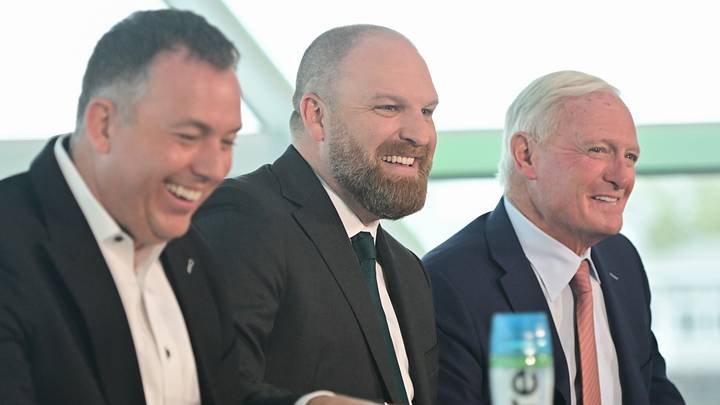
This isn't a rebuild; it's a build. That sentiment was echoed by Bucks GM Jon Horst, owner Wes Edens, and even new head coach Taylor Jenkins as a fundamental organizational philosophy about where the Bucks stand at the team's Media Day festivities on Monday in Downtown Milwaukee.
But what is the difference, really? A rebuild insinuates building back from something, whereas a build refers to something new entirely. They can be used interchangeably, for the most part, but that distinction means something deeper to the Bucks at this phase of their organizational lifecycle.
Milwaukee is resetting its culture entirely and building toward a future they don't fully understand yet. For a time, the Milwaukee Bucks were the winningest team in the NBA, with a clear-cut culture carried through by a superstar player and the fundamental building blocks of players who comprised their lineup, tinkering and retooling until 2021, when they finally found the perfect formula.
But that formula only worked for a short period, as is life in the NBA. Every year, trends emerge, teams learn from the previous year's Playoffs, and they must adapt to something new. The Bucks didn't adapt over the last few years, staying resolute in their culture and process of handling business until this summer; it came to a head and they finally accepted that it could not be done the same way.
The modern NBA forces teams to adapt and evolve, even when they don't want to, and Milwaukee finally conceded to the force of the league this summer, which is why they don't view this as a rebuild from the ashes of the former era, but instead as a build into whatever that next iteration will be.
The Milwaukee Bucks' roster transformed this summer, but so did their organizational philosophy.
Some things about the Bucks will never change. They remain committed to being a staple of the community and elevating the City of Milwaukee however they can. Some of the core concepts that made the Bucks such a successful team are still important to them today, as Horst and Jenkins outlined for the media.
They want a culture of hard work and camaraderie, just like they had during the most successful era in franchise history, only a few years ago. They want unselfish, high-character players who are willing not only to work tirelessly to improve personally, but also to contribute to something larger than themselves. They want egos to fade into the background and work ethic at the forefront.
But the specifics of what they need out of these players are changing, too. Horst outlined several key factors: positional size, versatility, and advantage creators. Taking the big three of Giannis, Khris, and Jrue out of the equation, these are concepts we'd associate more with the 2025-26 Knicks or 2024-25 Thunder than the 2021 champion Bucks.
Because the game has changed around them, so have the ways that rosters are constructed. The Bucks don't have possession of their own first-round pick until 2031, so building through the draft or tanking aren't options. Instead, they'll try to build organically through player development, drafting wherever they can, and setting a standard within the locker room that every player must reach.
Ironically, their new method aligns more closely with the philosophy we've seen from Pat Riley and the Heat over the years. The Heat don't bottom out. They compete every year, even when they know they're not going all the way, and they don't lose sight of that ultimate goal. They make smart, savvy, forward-thinking business decisions, and when they have all the puzzle pieces in place, they go all-in for the player that puts them over the top.
Milwaukee's leadership knows this path won't be an easy one, and it might take a while for fans to see the vision. But this is what it takes to be a great franchise in the modern NBA, and all they can do now is trust their plan, buy into their culture, and live up to that standard every day.
 Add us as a preferred source on Google