

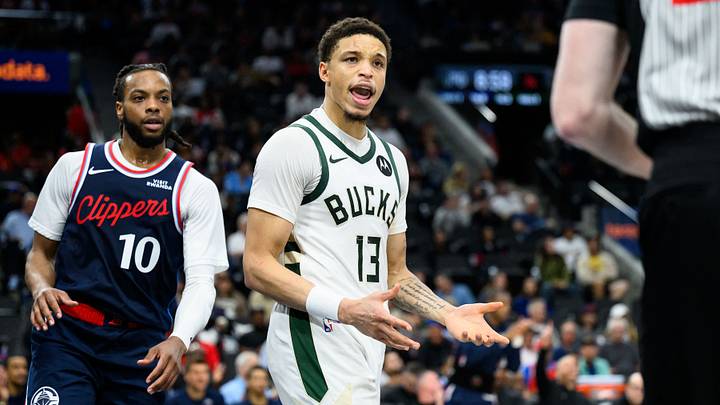
During a season that felt like Bucks fans were transported into the Twilight Zone, the breakout campaign of combo guard Ryan Rollins was the saving grace that gave Milwaukee hope. The 23-year-old, who signed an extremely team-friendly deal the summer prior, made massive leaps across the board statistically, setting career highs with 17.3 points, 5.6 assists, 4.6 rebounds and 1.5 steals per game while asserting himself as one of the best two-way guards in basketball.
But that doesn't mean the season was without concern, as Rollins himself would probably admit. His handle wasn't always as tight as it could've been. He had some fouls and turnovers that he wishes he could get back. And his team wasn't able to get over the hump and make the Playoffs, as they hoped.
More so than any of those issues, however, it was the transition offense that fell stagnant with Rollins leading the way, as highlighted by a recent statistical analysis of transition offense by the 50 players with the most reps in that area by Basketball University.
2025-26 Top 50 in Total transition Possessions…
— Basketball University (@UofBasketball) August 13, 2026
⬆️ More Efficient in Transition
➡️ More Transition Possessions
Pace pushers! pic.twitter.com/jZSj8VAz7M
Rollins found himself as one of the least impactful players in transition among the top 50 leaders in transition possessions, and not for a lack of trying. Milwaukee wanted to push the pace in theory, as outlined time and time again by Doc Rivers, but lacked the personnel to do it efficiently without Giannis Antetokounmpo on the court. So that left Rollins along to bear the consequences in transition, leading to a dreadful stat profile in an otherwise fantastic season.
If Ryan Rollins wants to be the Bucks' point guard of the future, he needs to be better in transition.
For a player who tips as many passes and forces as many turnovers as Rollins does, he needs to learn how to capitalize on those opportunities better. Milwaukee would oftentimes try to push the pace in transition, only for Rollins to realize the numbers were against him, pulling back to the perimeter for a reset or taking a low-quality shot in the process.
This speaks to a broader conversation about Rollins' decision-making, and how if he's going to become the elite starting point guard he flashed signs of last year, it's going to take a certain amount of discipline to get there. Whether that's adding a move or two to his bag, pushing the tempo a little quicker, or learning when to pull up in transition versus attack the rack, there are plenty of routes for him to do this.
But Milwaukee isn't going to stop trying to force defensive turnovers. That's how the makeup of this team is designed, and the responsibility isn't going anywhere for a player who's unquestionably a pillar of this Bucks rebuild. They want to continue empowering the development of what's effectively a homegrown talent in Rollins, and while there might be a little bit more competition for touches, his involvement is not going to change.
So this is the area where Rollins has the most opportunity to grow as he enters another season that could change the course of his career in the NBA, and if it translates to a payday the following summer, could impact the rest of his life.
 Add us as a preferred source on Google