

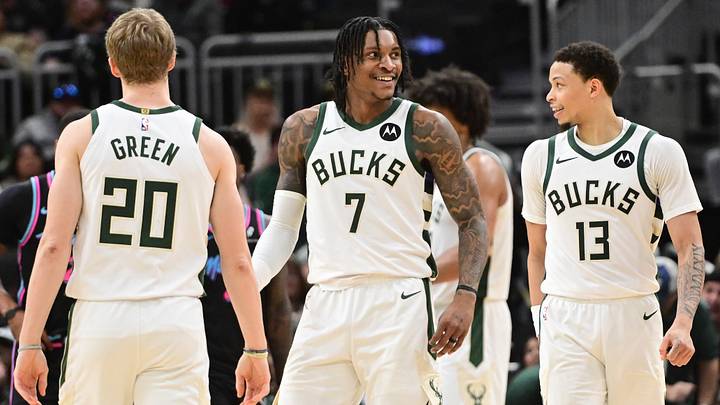
The Milwaukee Bucks have 96 guard minutes to distribute each game this season. Those may be the 96 minutes that new head coach Taylor Jenkins has the hardest time sorting out.
The center rotation is clear: Myles Turner and Kel’el Ware should soak up nearly every available minute. Jenkins mostly has to decide how to divide them — and whether there are stretches when they can share the floor.
Forward is relatively straightforward, too. If the Bucks are playing to win, Kyle Kuzma and Jaime Jaquez Jr. should handle most of the minutes at the 4, with Ware potentially stealing a few in bigger lineups. Nate Ament and Ousmane Dieng could also see time at the 3.
Then we get to the guards, where the clean math disappears.
The numbers game
96. That’s how many guard minutes Jenkins has to distribute each night—48 at point guard and 48 at shooting guard. Those point guard minutes will carry more weight this season. Giannis Antetokounmpo often served as Milwaukee’s de facto point guard and primary playmaker. Without him, the Bucks will need more traditional ball-handling and creation from their backcourt.
7. That’s how many players have a strong case for playing time: Tyler Herro, Gary Trent Jr., A.J. Green, Brayden Burries, Kevin Porter Jr., Ryan Rollins, and Kasparas Jakučionis.
Herro, Porter Jr., and Rollins are the closest things to locks. The other four have plausible cases for both playing and falling out of the rotation.
Trent is coming off his worst season since his rookie campaign. Green remains primarily a shooting specialist. Burries is a rookie who may need time to adjust to the NBA’s speed and physicality. Jakučionis has yet to prove himself at this level.
165. That’s how many minutes six of those seven guards combined to average last season. That total doesn’t include Caris LeVert (more on him later), Burries (who was still in college), or two-way players Cormac Ryan and Kam Jones.
Jenkins has to squeeze those 165 minutes into the 96 available. The math will force some difficult decisions.
How to make the math work
Jenkins and the Bucks’ front office will have to make the math work at some point this season. Milwaukee has too many players to carry on its opening-night roster, along with two guards entering the final years of their contracts.
Here are four ways the Bucks could begin creating minutes for the players they want to prioritize.
Waive LeVert
The Bucks must remove two players before the regular season tips off. Pete Nance’s non-guaranteed contract offers the simplest financial solution, but Milwaukee will need another cut. My money is on LeVert.
Milwaukee acquired LeVert from the Detroit Pistons as part of a larger trade that created cap savings for Detroit. He is coming off a down year and doesn’t have an obvious role in the Bucks’ crowded guard rotation.
Trent Jr.’s contract gets voided
This would be the Bucks’ dream scenario. For reasons that remain difficult to explain on basketball grounds, Milwaukee rewarded Trent Jr.’s worst season since his rookie campaign with a four-year, $64 million contract. How nice of them.
The Bucks would presumably love for the NBA to void the contract for cap circumvention and stop there. That would amount to a free bailout. If the league determines that Milwaukee broke the rules, however, it could void the deal and impose additional penalties, potentially including the loss of draft capital.
Trade Herro or Porter Jr.
Both Herro and Porter Jr. are entering the final years of their contracts and can become unrestricted free agents next summer. If Milwaukee doesn’t intend to re-sign them, it won’t want to watch either player leave for nothing.
The Bucks must decide whether either player—perhaps both—belongs in their long-term plans. That decision may not come until the trade deadline, but it will come eventually.
Moving either guard would open a large block of minutes for the players behind him on the depth chart. It also feels like the most likely long-term solution. The biggest question is when it happens.
Borrow minutes from the wing
The Bucks could manufacture additional minutes by borrowing them from the wing and lean into smaller lineups.The Bucks are thinner at the 3, where their options are largely unproven, unreliable, or both.
Milwaukee could use three-guard units, sliding one of them up to the 3. Those groups would carry obvious defensive risks, but the Bucks may have enough size, strength and toughness in certain combinations to survive.
Rollins, Porter Jr., Burries and Jakučionis each offer intriguing blends of length and strength. They could help Milwaukee survive stretches with three guards on the court while creating additional backcourt minutes.
It wouldn’t solve the equation, but it would make the numbers slightly more manageable.
 Add us as a preferred source on Google