

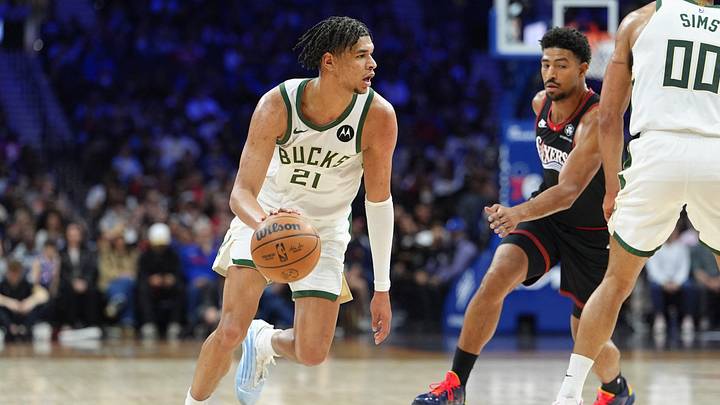
Ousmane Dieng enjoyed a breakthrough campaign after landing with the Milwaukee Bucks midway through last season. Now comes the harder part: proving it wasn’t a fluke.
Milwaukee acquired Dieng as part of a complicated three-team trade in early February. Ultimately, the Bucks sent Cole Anthony and Amir Coffey to the Phoenix Suns, while the Chicago Bulls landed Nick Richards.
In 30 games with the Bucks, Dieng averaged a career-high 11 points per game to go along with 4.6 rebounds and 3.6 assists.
While the production was encouraging, the efficiency was sorely lacking.
Of the 127 players who attempted at least 10 shots per game and appeared in 10 contests after February 5—the day Dieng was traded—he ranked 110th in field goal percentage at 42.3 percent.
With Dieng’s rookie contract expiring after the season, Milwaukee declined to extend him a qualifying offer, making him an unrestricted free agent. Instead, the Bucks brought him back on a team-friendly three-year, $17.5 million deal with a team option for the final season. The contract will pay him a flat $5.75 million per year.
Still only 23 years old, Dieng should have plenty of room to grow. After showing flashes of something more down the stretch last season, his next challenge is turning those flashes into a sustainable role.
Here’s one realistic and one ambitious goal for Dieng in 2026-27.
Realistic goal: Earn a regular spot in the rotation
Dieng has never been short on potential. The 11th overall pick in the 2022 NBA Draft spent the first three-plus seasons of his career with the Oklahoma City Thunder before arriving in Milwaukee.
At 6-foot-9, he possesses an intriguing blend of size and skill on the wing. He can shoot a little, handle the rock a little and create some offense for himself and others.
The problem is that he has yet to develop one elite skill he can consistently hang his hat on. That made it difficult for him to crack Oklahoma City’s loaded rotation and eventually helped lead to his departure.
He’ll try to avoid the same fate in Milwaukee.
The Bucks may not have a top-heavy rotation, but they are deeper than they initially appear. Most of that depth is concentrated in the backcourt, but the ripple effect could still squeeze someone like Dieng out of regular minutes.
At guard, Tyler Herro, Kevin Porter Jr., Ryan Rollins and Brayden Burries should all command significant playing time. Kyle Kuzma and Jaime Jaquez Jr. figure to soak up plenty of minutes at forward, while Myles Turner and Kel’el Ware sit atop the center rotation.
That’s already eight players with a strong claim to regular minutes, and it doesn’t even include Nate Ament, Kasparas Jakucionis, AJ Green, Gary Trent Jr. or Jericho Sims.
The rotation will get crowded in a hurry, and Taylor Jenkins simply won’t be able to play everyone.
That makes Dieng’s realistic goal fairly straightforward: establish himself as one of Milwaukee’s top nine rotation players.
A trade or injury could certainly create additional opportunities, but Dieng can’t count on either. He’ll have to force Jenkins’ hand by defending, making quick decisions and providing enough shooting to complement Milwaukee’s higher-usage players.
He showed last season that he belongs in the NBA. This year is about proving he deserves a consistent role in it.
Ambitious goal: Shoot 36 percent while attempting at least four three-pointers per game
Dieng’s role should look much different this season than it did during his first few months in Milwaukee.
The Bucks were mostly out of the playoff race by the time Dieng arrived last year, allowing them to experiment with lineups that frequently asked him to create offense.
That added responsibility helps explain some of his inefficiency. Dieng shot 42.3 percent from the field, 33.1 percent from deep and posted an effective field goal percentage below 50 percent. His turnovers also climbed to 2.2 per game.
With Herro, Porter Jr., Rollins and Burries now available to handle much of the creation burden, Dieng should spend considerably more time playing off the ball.
That means his jumper becomes even more important.
Dieng increased his three-point volume to 4.5 attempts per game after joining Milwaukee, but nearly half of those attempts came off the dribble. That balance should shift this season, with Dieng getting more opportunities to spot up around Milwaukee’s primary creators.
Fortunately, that’s a role he has already shown he can handle.
He connected on an impressive 38.8 percent of his catch-and-shoot threes last season after hitting 36.8 percent the year before.
The next step is maintaining that efficiency while embracing the role on a larger scale.
If Dieng can knock down 36 percent of his threes while taking at least four per game, defenses will have to respect him away from the ball. That would open driving lanes for Milwaukee’s guards, make Dieng easier to fit into different lineups and give him the kind of reliable offensive skill he has been searching for since entering the league.
The talent has always made Dieng intriguing. Becoming a dependable floor-spacer could finally give that talent a clearly defined NBA role.
 Add us as a preferred source on Google