

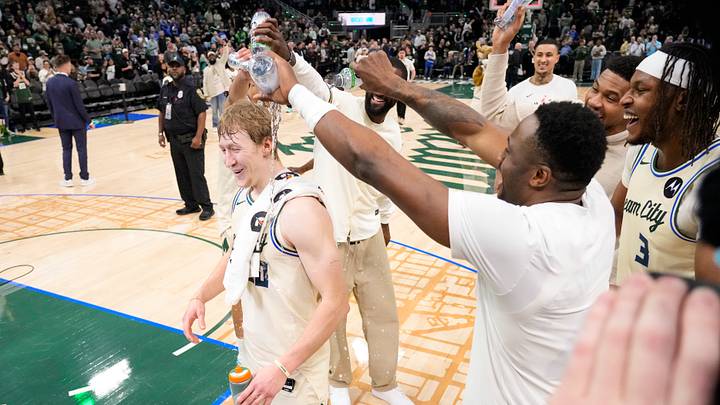
AJ Green has already been one of the Milwaukee Bucks’ best success stories. Now, the hope is that the buck doesn’t stop here (pun fully intended).
After lighting up the scoreboard for four years at Northern Iowa and finishing fourth on the school’s all-time scoring list, Green went undrafted in 2022. Thankfully for Milwaukee, the Bucks scooped him up on a two-way deal.
He appeared in 35 games during his rookie season and knocked down 41.9 percent of his threes, showing enough promise for Milwaukee to sign him to a three-year deal worth $6.3 million in the summer of 2023.
Once again, Green outplayed his contract.
His scoring average increased in each of the next three seasons, culminating in his most productive campaign yet in 2025-26. Even during a disappointing season for the Bucks, Green averaged career highs of 10.4 points, 1.9 assists and 2.7 rebounds per game.
Milwaukee had already seen enough before that breakout, rewarding Green with a four-year, $45 million extension that kicks in this season. He’ll earn $10 million in 2026-27, $10.8 million in 2027-28, $11.7 million in 2028-29 and $12.5 million the following year.
With the pay raise comes another challenge: proving there are still more levels to his game.
Here’s one realistic and one ambitious goal for Green in 2026-27.
Realistic goal: Shoot 42 percent on seven three-point attempts per game
Green may be hard-pressed to find the same number of opportunities he received last season, when Giannis Antetokounmpo and Kevin Porter Jr. both missed significant time and Milwaukee fell out of playoff contention over the final month-and-a-half of the season.
Heck, Green may not even be guaranteed a regular rotation spot.
The Bucks have a logjam at guard that includes Porter Jr., Tyler Herro, Ryan Rollins, Brayden Burries, Gary Trent Jr. and Kasparas Jakucionis. If Green slides up to the wing, he’ll also be battling Nate Ament, Kyle Kuzma, Jaime Jaquez Jr. and Ousmane Dieng for minutes.
If there’s one thing we’ve learned about Green, however, it’s that he has a habit of forcing his way onto the floor.
Assuming he once again proves himself worthy of a rotation spot, his realistic goal should be maintaining elite efficiency while continuing to fire away from deep: at least 42 percent on roughly seven three-point attempts per game.
That would closely mirror last season, when he connected on 41.9 percent of his 7.1 attempts per game. The difference is that those shots may come in an even more off-ball role given the number of creators Milwaukee now has on the roster.
That shouldn’t necessarily be a bad thing. If Herro, Porter Jr., Rollins and Burries are collapsing defenses, Green’s job becomes fairly simple: keep moving, stay ready and punish teams for leaving him.
Maintaining elite accuracy and volume despite a changing role would reaffirm what Milwaukee already believes—that Green is one of the NBA’s most dangerous floor-spacers.
Ambitious goal: Take at least 10 percent of his shots within three feet of the hoop
If Green wants to take another step in his development, he’ll need to expand his game beyond simply launching threes.
He’s unlikely to become a primary ball-handler, so the most realistic path toward becoming a more complete offensive player is finding ways to leverage the threat of his jumper into easier looks at the rim.
Take JJ Redick, for example.
Redick made 41.5 percent of his career three-point attempts, almost identical to Green’s career mark of 42 percent. However, he learned how to use the threat of his jumper to create other opportunities, attacking off curls, backdoor cuts and hard closeouts when defenders sold out to take away the three.
From 2009-10 through 2013-14, when Redick was between 25 and 29 years old, he took roughly 10 to 15 percent of his shots within three feet of the basket.
Kyle Korver offers another useful comparison. He was one of the greatest shooters of his generation, connecting on 42.9 percent of his career three-point attempts.
Korver never attacked the rim as frequently as Redick, but he still had four seasons in which at least nine percent of his shots came from within three feet.
Green hasn’t come close to that yet.
Only 2.8 percent of his career field-goal attempts have come at the rim, while a whopping 87.4 percent have come from behind the arc.
To be clear, nobody should be asking Green to shoot fewer threes. That would defeat the purpose of having him on the floor.
Instead, the next evolution of his game should come when defenses overreact to that shooting threat. Turn a few mid-range attempts into backdoor cuts. Attack an occasional hard closeout. Slip behind a defender who loses sight of him while chasing him around the arc.
Getting 10 percent of his shots at the rim would represent a significant shift, but that’s what makes it an ambitious goal.
Green has already proven he can thrive as an elite specialist. If he can start using the threat of his jumper to manufacture easier baskets, he could become an even more difficult player for defenses to scheme against—and another example of Milwaukee squeezing more development out of a player who has already exceeded expectations at every stop.
 Add us as a preferred source on Google