

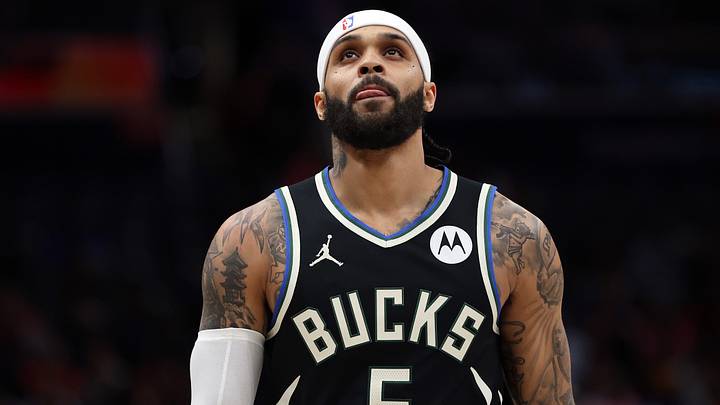
With the Kawhi Leonard dilemma in the rearview and the LA Clippers coming to terms with their punishment, many eyes have turned back to the investigation into the Bucks' latest contract with Gary Trent Jr. Fans and analysts have found the long term extension suspicious since it was first reported in mid-July, roughly two weeks after free agency began, because of the current market value of NBA contracts.
The 27-year-old, coming off his worst season as a pro, averaged just 8.1 points on a dreadful 38.7% from the field coming off the bench for the Bucks. The rampant online speculation has honed in on the idea that the Bucks and Trent's agents at Klutch Sports reached under-the-table agreements for the swingman to sign back-to-back veteran minimum deals before agreeing to this new long-term extension this summer.
In his new report on the subject, The Athletic's Joe Vardon wrote the following about the potential punishments Milwaukee could face: "If league investigators find proof that the Bucks and Trent are guilty of what the Clippers and Leonard were guilty of, the punishment could be equally severe, if not worse."
We just witnessed one of the most blatant acts of salary cap circumvention in the history of American professional sports, which took more than a year of research by journalists and independent investigators to uncover a plot that led to a probe by the U.S. Justice Department.
To treat these accusations in the same vein as the Clippers situation, or impose penalties that harsh, would not only undermine the league's ruling on Steve Ballmer and Kawhi, but likely expose itself to dangerous criticisms from the National Basketball Players Association and broader public.
Dropping the hammer on the Milwaukee Bucks for taking care of their players would set the NBA back far more than it even realizes.
It sets a dangerous precedent if the NBA crashes down on the Bucks, but to understand that, we need to first look at the process. Trent wasn't the first free agent the Bucks talked to or even signed. With financial and roster flexibility they weren't fully prepared for after the Giannis trade, Milwaukee prioritized re-signing some of its most promising young players before turning attention to new additions on the open market. It was a relatively weak class in that regard, and the Bucks ultimately landed back with Trent as a real option to help them flesh out their cap sheet.
Of course, teams can't agree to pay players later for taking minimum deals now to earn larger paydays later. But unless the league finds a paper trail or other concrete evidence of collusion occurring, then dropping the hammer on Milwaukee and Klutch Sports would open a whole new can of worms that Adam Silver should hope to avoid.
Players run the league far more than many casual spectators realize, but without the talent, what is the NBA? We come to this league for the highest level of competition in the game on the biggest stages in the world. If players feel like the league is restricting their earning potential, they'll have another lockout on their hands before they know it.
In Gary Trent Jr.'s case, this is a player who bet on the pitch Milwaukee gave him. The idea from the Bucks' front office was essentially: sign with us on a minimum now, and you'll earn a larger contract on the open market when Giannis' gravity helps you set new career records in 3-point shooting.
That seemed to work at first, until Klutch learned that his market wasn't what they expected it to be in the first go-around. So they re-signed on a slightly larger deal, and the Bucks completely collapsed during the season, tanking Trent's numbers and role in the process. How was he supposed to get a deal that was commensurate with his talent at that point?
It's safe to say the Bucks' pitch to Trent and Klutch this summer looked something like this: "Thank you for believing in us. We're sorry it hasn't worked out how we expected, but we appreciate your sacrifice, and we still believe in you. We'd like to offer you a contract that reflects the level of play we feel you're capable of reaching and probably deserve."
If small market teams can't build by rehabilitating players' value, and they're not supposed to tank, then how are they supposed to build enough equity to compete in the trade market or build contention-level teams to attract more talent?
On the flip side, if role players don't have opportunities to build trust and equity within an organization to earn a substantial contract, then what does that say about the state of the NBA's middle class?
If the league drops the hammer on a team for giving the equivalent of a mid-level exception to a player who sacrificed a lot for them, how are the non-stars supposed to get paid?
The NBA's ruling in Gary Trent Jr.'s new deal with the Bucks could have terrible consequences for role players across the NBA.
Most of the money goes to superstar players, who will leave if you don't give them the supermax they're entitled to by the CBA for reaching certain milestones. This percentage-based salary structure is a concept the NBA designed and agreed to years ago. However, this system leaves mid-level exceptions and minimum deals as almost the only remaining route for teams to build the rest of their roster, unless they have Bird Rights on a player or an owner who's willing to spend millions on the luxury tax.
Before his two minimum deals in Milwaukee, Trent played on a 3-year deal with the Raptors in which he made more than $17 million annually. His average annual value on this new deal is about $15 million, for a player who had arguably the best non-Giannis Playoff performance for the entire Bucks franchise since the 2021 title run. How are small-market teams supposed to build if they can't give goodwill contracts back to the players who invest in them?
By that same logic, is the NBA going to investigate the Bucks for signing Bobby Portis to a new contract last offseason, too? 2021 champion Pat Connaughton wasn't worth the 3-year, $28.5 million deal he got with Milwaukee in 2022 either, but no one batted an eye at that one.
The NBA had a responsibility to drop the hammer on the Clippers because they harmed the competitive balance of the league. In the Clippers' situation, Kawhi was a champion and MVP candidate whose embattled uncle and former agent allegedly orchestrated shady side deals with a franchise that was repeatedly warned about these rules. That blew up in the faces of the parties involved and the league itself on a global scale.
At most, Trent's minimum contracts with the Bucks helped them win one Playoff game, and Giannis still forced his way out. This fanbase has been through enough this summer, and if the worst-case scenario comes to be, we have to hope that Adam Silver at least considers how his punishment would harm an entire city and its economy for the next several years, in a way the Clippers situation simply does not compare.
 Add us as a preferred source on Google