

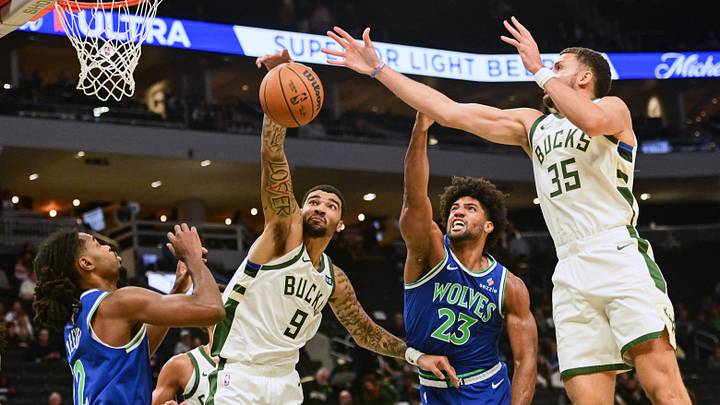
The Milwaukee Bucks are embracing several philosophical changes under new head coach Taylor Jenkins. One of the most noticeable differences will be on the offensive glass.
Milwaukee ranked dead last in offensive rebound percentage under you-know-who in each of the last two seasons. In fact, their struggles on the offensive glass run much deeper: it has been 13 years since the Bucks last appeared in the top ten in offensive rebounding percentage, according to Cleaning the Glass.
Jenkins will (try to) reverse the Bucks’ trend this season.
The Memphis Grizzlies ranked in the top five in offensive rebounding in four of Taylor’s final five seasons. And Jenkins is intent on continuing that trend in Milwaukee.
Teams have a variety of strategies for offensive rebounding. For example, they might send players to crash the glass if they’re in certain zones on the court, assign designated offensive rebounders to each lineup, or instruct players to attack the boards from the corners.
It appears Jenkins wants everyone except the shooter to hit the glass. In an interview with Jim Owczarski of the Milwaukee Journal Sentinel, Jenkins said, “We wanna crash. Outside of the guy that takes the shot, we’re having four guys attack the offensive glass.”
We saw that in Milwaukee’s first preseason game against the Minnesota Timberwolves. The Bucks grabbed their own rebound on about 30 percent of their missed shots, a percentage that would’ve ranked eighth in the NBA last season.
The Bucks routinely sent multiple players to the paint on their own shot, and it paid off.
Milwaukee recorded 14 offensive rebounds that turned into 20 second-chance points. That’s going to be an important component of their offense this season, given the lack of playmakers and shot creators on their roster.
Of course, it’s not all sunshine and rainbows when it comes to offensive rebounding.
Teams are hesitant to crash because it opens up transition opportunities for the opposing team. And the Timberwolves saw a ton of open-court looks as a result.
Minnesota finished the game with 26 fast-break points, with most coming directly off a Bucks miss.
Tyler Herro misses the 14-foot jumper to begin the video clip above. The other four Bucks crash the glass. Three of the four have two feet in the paint, with the fourth, Jaime Jaquez, several feet below the free throw line. The only player not in the frame on the rebound is Herro as the shooter.
Bones Hyland goes up and snags the rebound, takes a couple of outlet dribbles and tosses the ball to Anthony Edwards near halfcourt.
As Edwards takes his first dribble and looks up court, he sees the 7-foot-1 Rudy Gobert running alongside Herro. Stuck in no-man's land, Herro needs to stop the ball, opening up an easy lob to Gobert over the top.
This scenario played out several times throughout the games, as the Bucks were undisciplined in getting back after crashing the boards.
To be fair, it’s a delicate balance. Jenkins understands the strategy involved, and wants his guys to muck up transition after crashing. He told Owczarski in the same interview, “If we don’t get the board, now we’re in position to flip it. We’re taking away their pace. Now they don’t know where the numbers are. They don’t know where the space is because we condensed it.”
Jenkins emphasizes clogging the running lanes to disrupt the opposing team's transition game. He is determined to prevent easy outlet passes that lead to fast-break opportunities, like in the clip above.
It was only the first game of the Jenkins era, and the Bucks showed there is still work to do in mastering this balance. Offensive rebounding can be a difference-maker, but it comes with real risks Milwaukee must address if it wants to contend.
Can they simultaneously create extra offensive possessions for themselves without exposing their neck in transition? It’s a tough needle to thread, and only time will tell.
 Add us as a preferred source on Google